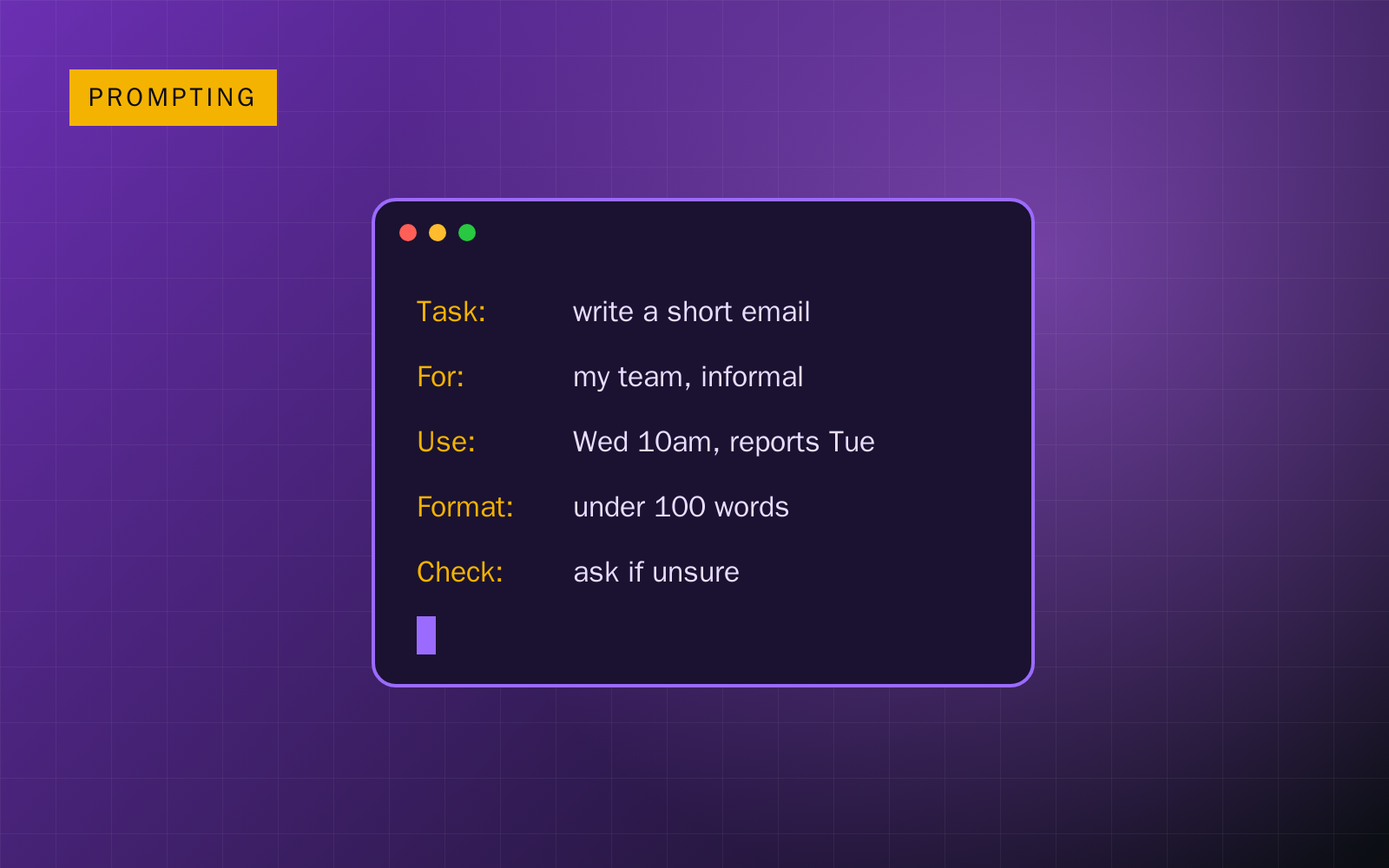
When an AI chatbot gives you a bland or wrong answer, the prompt is often the problem. The model only knows what you tell it. A good prompt doesn't need magic words. It needs the same things a capable new colleague would need to do the job well.
The 5-part method
- Task: say exactly what you want produced.
- Context: who it's for and why.
- Details: the facts, material and constraints it must use.
- Format: length, structure, tone.
- Check: ask it to flag uncertainty, then review the answer yourself.
Before and after
Weak prompt:
Write an email about the meeting.The model has to guess which meeting, who's reading, what to say and how long it should be. You'll get something generic.
Better prompt:
Write a short email to my team (8 people, informal) telling them
our weekly meeting has moved from Monday to Wednesday at 10am,
starting next week, because the client call now happens on Mondays.
Ask them to send their weekly reports by Tuesday evening instead.
Keep it under 100 words, friendly, no exclamation marks.
Every part of the method is there: the task (an email), context (team, informal, the reason), details (the new day, time and deadline), and format (under 100 words, the tone).
Tips that make the biggest difference
Give it the material instead of asking it to remember
Paste the document, data or notes you want it to work from, and say "use only the text below". The model is far more accurate working on text in front of it than recalling facts from training.
Show an example
If you want a particular style, include a sample: "Here are two product descriptions I like. Write one for this new product in the same style." One good example often beats a paragraph of description.
Ask for a structure
"Give me a table with columns: option, cost, pros, cons" or "Answer in 3 bullet points" makes answers easier to read and easier to check.
Break big jobs into steps
Instead of "write my business plan", go step by step: outline first, then each section, reviewing as you go. You stay in control, and errors don't pile up.
Let it ask questions
Add "Before you start, ask me any questions you need answered." This is one of the easiest ways to stop the model guessing.
Iterate instead of starting over
The first answer is a draft. Reply with specific feedback: "shorter", "less formal", "the second point is wrong, it's Wednesday, not Thursday". The conversation keeps the context.
Ask it to admit uncertainty
Add "If you're not sure about something, say so instead of guessing." It won't eliminate mistakes (see how to check AI answers), but it helps.
A reusable template
Task: [what to produce]
For: [audience] because [purpose]
Use this information: [paste facts, notes, documents]
Constraints: [must include / must avoid]
Format: [length, structure, tone]
If anything is unclear or you're unsure, ask or say so.
What not to put in a prompt
Don't paste passwords, bank details, private customer data or anything confidential into a public AI tool unless you know how that service handles your data. Our AI safety and privacy guide explains what to check.
Practice
Take the last vague prompt you used and rewrite it with the five parts. Compare the two answers. The difference is usually obvious straight away.
Key points
- Give the task, context, details, format, and ask it to flag uncertainty.
- Paste the source material instead of asking the model to remember facts.
- One good example often works better than a long description.
- Treat the first answer as a draft and give specific feedback.
- Keep passwords and private data out of public AI tools.